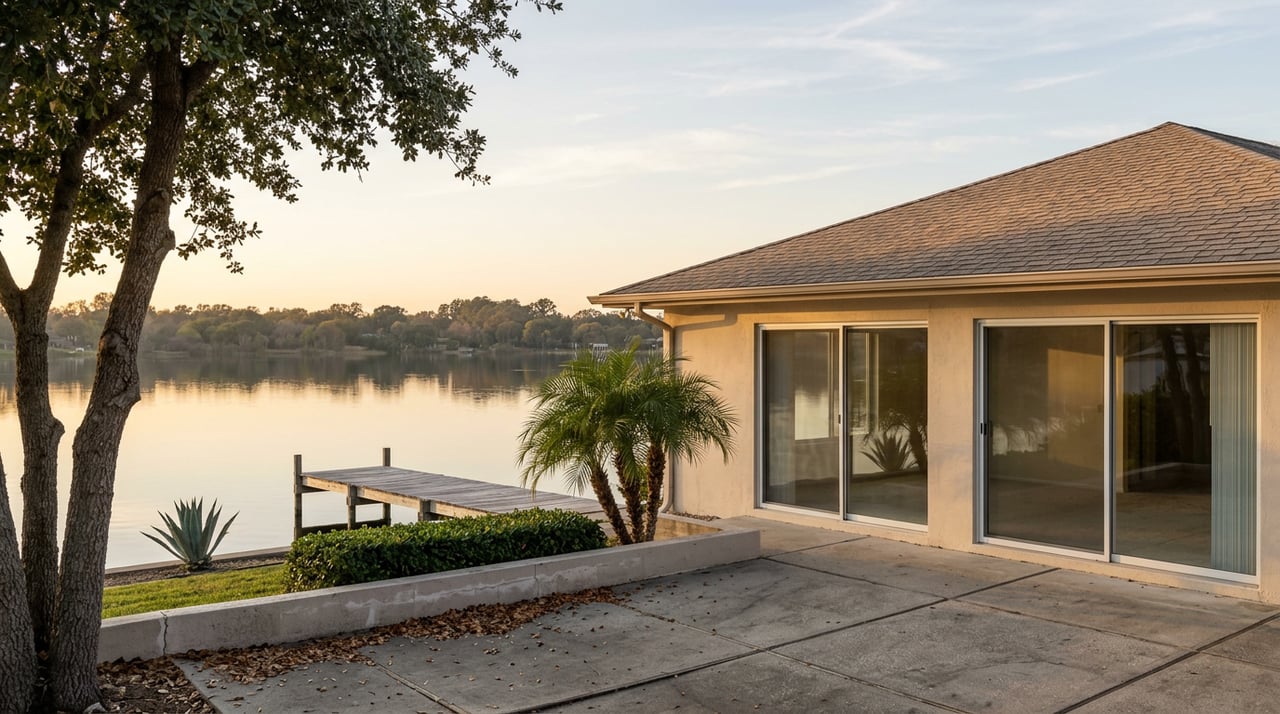
The Lake Mission Viejo Fee That Doesn't Show Up Until You're in Escrow
September 3, 2026
September 3, 2026
A buyer in Mission Viejo can spend weeks comparing school boundaries, HOA dues, and square footage, then get a surprise three days before closing: a second invoice from an organization that never appeared on the listing sheet. It's not a scam and it's not negotiable. It's Lake Mission Viejo, and if the home is eligible, membership comes with the deed whether anyone budgeted for it or not.
The lake itself is not the problem. At roughly $32 a month, the Lake Mission Viejo Association assessment is one of the cheaper line items in the entire transaction. The problem is what that small number is attached to: a permanent legal obligation that transfers with the property, paperwork that even the association's own website can't fully agree on, and a fee schedule that has moved more in three years than most buyers expect from what looks like a rounding error on a closing statement.
Lake Mission Viejo Association covers more than 25,000 properties across the city, according to the association's own membership page. It governs the 125-surface-acre private lake, its two beaches at North Beach and East Beach, the marina, and the summer concert series that most residents think of as the neighborhood's signature amenity. None of that is optional once a home qualifies. Membership is written into the property's CC&Rs, and California treats an HOA's governing documents as a binding contract that transfers with ownership, not a subscription a buyer can decline at the closing table.
That matters because LMVA is a separate legal entity from whatever neighborhood HOA already governs the home. A buyer in Casta del Sol or Painted Trails is not choosing between a neighborhood association and the lake association. In most eligible streets, both apply, stacked as two distinct bills with two distinct boards and two distinct sets of rules.
Here's where the friction actually shows up. Anyone who searches for the LMVA transfer fee before writing an offer will find two different answers depending on which page loads first.
| LMVA Web Page | Transfer Fee Listed |
|---|---|
| Assessment & Fees (legacy page) | $250 |
| Escrow Information page | $300 |
| Fee and Fine Schedule (PDF, last updated May 2024) | $300 |
The legacy Assessment & Fees page still lists a $250 transfer fee for membership changing hands in a sale. The association's Escrow Information page and its fee and fine schedule, both last updated in 2024, list $300 instead. This is not a rumor from a message board. It's the same organization publishing two different figures across its own pages, and an escrow officer working from an older printout could hand a buyer or seller the wrong number.
The practical fix is simple but easy to skip: confirm the current transfer fee directly with the LMVA membership office before escrow closes, rather than trusting whichever page a Google search surfaces first. A $50 discrepancy rarely kills a deal, but it's the kind of detail that erodes trust in the last week of a transaction when everyone involved is already tired of paperwork.
The eligibility rules add a second layer that catches people off guard, especially on older streets. Any home built in 1978 or later within LMVA's boundaries comes with membership already attached to the property, according to the association's own eligibility page. There's no opting in or out. It arrived with the house.
Homes built before 1978, back when the Mission Viejo Company was still developing the area and before LMVA formally existed, were only ever offered membership. The original owners could accept or decline. But once a pre-1978 home accepts membership, that decision becomes permanent and transfers to every future owner, the same as a post-1978 home. The offer to join still stands today for any pre-1978 home that never enrolled, but once accepted, there's no exit ramp.
The only apartment complex in the city with LMVA membership is Vista del Lago, according to the association. Every other unit type that carries membership is a single-family home or condominium, which is worth knowing if a buyer is comparing a Vista del Lago unit against a similar-looking building down the street that carries no lake access at all.
The dollar figure itself is small, but it hasn't been flat. The LMVA's own billing and budget disclosures show the semi-annual assessment moving from $156 in 2023 to $179 effective January 1, 2025, to $193 for 2026. That's roughly a 24 percent increase in three years on a fee most buyers treat as background noise.
The association's own 2025 budget disclosure points to a specific driver: rising wages for the hourly staff who run the facilities, including lifeguards, gate attendants, and maintenance personnel, with the board citing a further California minimum wage increase that took effect in 2025. Lake operations are labor-intensive in a way a typical landscaping-only HOA is not, which means LMVA's costs move with California wage law in a way that neighborhood associations without staffed amenities generally don't.
None of this makes the lake a bad deal. Two lifeguard-patrolled beaches, boat rentals, fishing, and a summer concert series for around $32 a month is still inexpensive by Orange County standards. The point is that a buyer reviewing the current $193 figure should also ask whether a pending increase or special assessment is already on the board's radar, the same way they'd ask about a neighborhood HOA's reserve study before removing contingencies.
The stacking effect is most visible in neighborhoods built during Mission Viejo's original development wave. Streets in Casta del Sol, Finisterra on the Lake, and Emerald Pointe date to the late 1970s through the mid-1980s, which means the pools, clubhouses, and lakeside docks tied to those neighborhood associations are decades past their original construction, on top of whatever LMVA charges separately for lake access.
That combination of an aging neighborhood HOA and a mandatory lake assessment is exactly where reserve studies matter most. California's insurance market has been tightening broadly over the past several years, and associations with waterfront assets like docks and shoreline retaining walls tend to feel that first, since those components are expensive to insure and expensive to replace. A buyer looking at a home in Canyon Crest's lakefront section or along the older tracts near Marguerite Parkway should ask not just what LMVA charges, but what the neighborhood-level HOA's reserve study says about the health of its own aging infrastructure.
A few questions, asked early, prevent most of the surprises above:
Every one of these is a document a seller is required to provide, and a buyer is entitled to review, before contingencies come off the table. Asking for them early costs nothing and prevents the kind of last-week scramble that makes an otherwise smooth escrow feel chaotic.
Can I decline Lake Mission Viejo membership if I buy an eligible home? No, not if the home was built in 1978 or later within LMVA's boundaries. Membership is already attached to the property and transfers automatically at sale. Only certain pre-1978 homes ever had a choice, and once that choice was made in favor of joining, it became permanent for all future owners.
What happens to lake privileges if I rent out the property? An owner can use the facilities personally or transfer lake privileges to a tenant for a $75 fee. The obligation to pay LMVA's assessments stays with the property owner either way, whether or not the tenant is the one swimming at North Beach.
Does every home in Mission Viejo carry LMVA membership? No. Most, but not all, single-family homes and condominiums in Mission Viejo are eligible, according to the association, and the property's CC&Rs determine which specific addresses qualify. The only way to know for certain is to confirm directly with the LMVA membership office before writing an offer.
If you're weighing a purchase or a sale on one of Mission Viejo's LMVA-eligible streets, the fee itself is rarely the issue. Getting the paperwork right before contingencies disappear is. Mike Doyle works these transactions across Mission Viejo's older and newer HOA-governed neighborhoods and can help confirm eligibility, current fees, and reserve study details before they become a problem in week three of escrow. Get your instant home valuation to start the conversation on the right footing.
Stay up to date on the latest real estate trends.

Ask a couple people how the housing market is doing and you’ll probably get a couple different answers. That’s because right now, the market runs on 2 very different t… Read more


It’s that time of year again—when rental property owners sharpen their pencils, look at the market, and ask the question: “What should I charge for rent?”

Ask around and almost every homebuyer out there wants to know if there’s a way to get a better deal. And just about every seller wants to know if they'll still get top… Read more
For expert real estate services, reach out to Mike Doyle. Whether you're buying, selling, or renting, navigate the process with confidence. Contact him today to ensure a smooth and informed real estate journey.