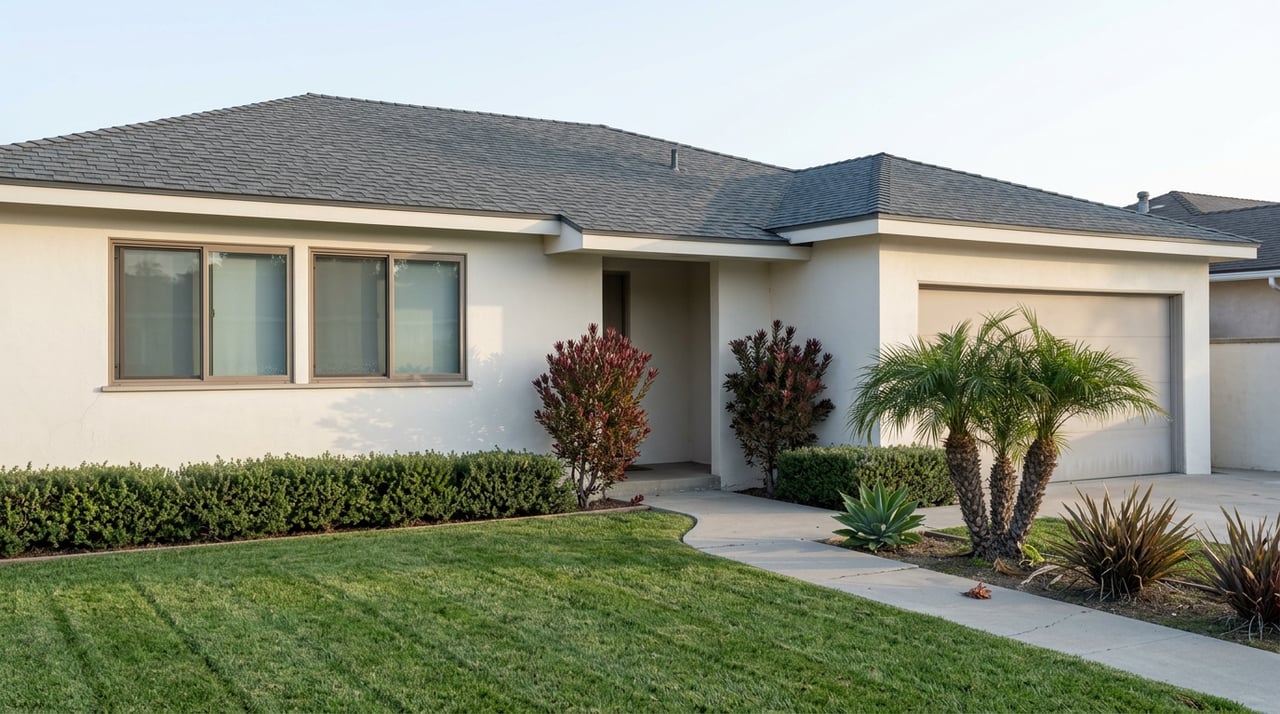
How Huntington Beach Price Per Square Foot Changes by Neighborhood
August 20, 2026
August 20, 2026
Ask three sources what a home costs in Huntington Beach this year and you'll get three numbers within a hundred thousand dollars of each other, all hovering somewhere around $1.3 to $1.4 million. The figures are close, but they combine distinct segments of the market. A three-month window ending in May 2026 puts the citywide median sale price at $1.4 million, and by June 2026 the same market was also producing single-family sales near $1.6 million and condo sales closer to $672,500. Those are not two ends of a spectrum. They're two different products being averaged into one number that describes neither.
The differences are clearer when you leave the citywide view and look at what's closing street by street. Over the three months ending in April 2026, homes in Downtown Huntington Beach sold at a median of $2.3 million, up 24.3 percent from the year before. That's not what the citywide median is telling you to expect.
This isn't a story about the city getting more expensive. It's about how the median combines different property types and locations, while financing, tax, permit, and HOA details can also affect a specific purchase.
Start with the split that's easiest to prove: property type. By June 2026, single-family homes in Huntington Beach were trading around $1.6 million while condos sat near $672,500. Blend those together and you get something close to the oft-quoted citywide figure, a number that isn't wrong so much as it's describing an average household that doesn't exist.
Now split by location instead of property type and the spread widens further.
| Submarket | Recent median | Price per square foot | Year over year | Days on market |
|---|---|---|---|---|
| Downtown (92648), 3 mo. ending April 2026 | $2.3 million | $992 | +24.3% | 53 |
| Seacliff, January 2026 | $2.2 million | $954 | +43.1% | 43 |
| Citywide, 3 mo. ending May 2026 | $1.4 million | $787 | +1.2% | 34 |
Downtown's premium isn't really a housing premium. It's a proximity premium to a 1,850-foot pier, Main Street's surf shops, and Pacific City, the kind of walkable core that pulls an estimated 11 million visitors a year. Buyers there are paying for a lifestyle product that happens to come with a roof. Treating the citywide median as a stand-in for Downtown means walking into a negotiation with the wrong number in your head.
One detail worth noting in Huntington Harbour is who owns the ground under the building, separate from view or dock access.
Harbour Vista is a gated complex of 275 condos built in 1980, and its owners don't own the land their units sit on. They lease it, currently for somewhere between $220 and $233 a month, stacked on top of HOA dues running $708 to $733 a month.
Compare that to The Gables, a guard-gated cluster of 80 Cape Cod-style townhomes also built in 1980, also on leased land. Ground rent there runs higher, $700 to $766 a month.
Two land-lease communities, built the same year and a few minutes apart, illustrate why a citywide median has no way to show you these details, and neither does a listing price by itself. Those details only show up when someone reviews the lease documents and monthly costs before an offer goes in.
Land leases are the most dramatic friction point, but they're not the only one that changes the real cost of a specific address.
Mello-Roos is a supplemental property tax tied to newer development districts, and it's not subject to the caps that ordinarily limit annual increases under California's Proposition 13. In Huntington Beach it shows up in Holly-Seacliff and in some tracts of Edwards Hill, adding $2,000 or more a year on top of the base tax bill. It does not show up in Brightwater, built by the same era of development but structured differently. Two newer neighborhoods, same general age of construction, meaningfully different ongoing tax exposure, and none of it visible in a sale price comparison.
Geography carries its own friction too. Properties west of Goldenwest Street or near Pacific Coast Highway can fall inside California's Coastal Zone. That zone includes Downtown, Sunset Beach, western Seacliff, and portions of Huntington Harbour, the same submarkets already commanding the steepest per-square-foot numbers in the table above.
HOA dues get treated like a lifestyle line item, something you weigh against amenities.
Gated, amenity-rich communities in Huntington Beach, the kind with pools, guard gates, and maintained common areas, carry HOA fees that commonly run $200 to $509 a month. The amenities are real, and the monthly dues are another cost to weigh alongside the sale price.
Brightwater is worth understanding on its own terms, because it's the exception that proves how constrained the rest of the map has become. It sits atop the Bolsa Chica Mesa, adjacent to the Bolsa Chica Ecological Reserve, and it was built by Woodbridge Pacific Group as a roughly 356-home master-planned community split into three sub-communities: Capri, built smaller with efficient indoor-outdoor layouts, Seaglass in the mid-size range drawing on Hampton and cottage influences, and Azurene at the top, with floor plans exceeding 4,000 square feet on the mesa's most coveted lots.
It's the last large-scale single-family community the city has built, reflecting the limited land available for another one. That scarcity is part of what's pushing new construction toward smaller infill projects and additions on existing lots rather than new neighborhoods, and it's a structural reason Brightwater and similarly positioned communities like Seacliff have kept appreciating even in stretches when other Downtown segments cooled.
None of this means the citywide median is useless. It's a fine starting point for a general sense of the market's direction. It should not be treated as a price for any specific home: lease terms, a tax district, HOA dues, and a property's coastal location are details to evaluate separately, since they are not reflected in the citywide median.
Does every Huntington Beach condo sit on leased land? No. Land-lease arrangements are specific to a handful of named communities, including Harbour Vista and The Gables. The lease term and current ground rent can be confirmed with the HOA or through the title report before an offer goes in.
Is Mello-Roos consistent across newer Huntington Beach neighborhoods? No. It depends on the specific tract. Holly-Seacliff and some Edwards Hill tracts carry it. Brightwater does not.
If you're comparing a specific Huntington Beach address against the number you saw on a portal, the questions worth asking are about the lease, the tax district, and the HOA math, not just the price. Mike Doyle can walk through those specifics for the neighborhood and property type you're actually considering. Get your instant home valuation to see where your target address falls when you compare the relevant details.
This article is general information, not legal, tax or financial advice. Consult a qualified professional about your situation.
Stay up to date on the latest real estate trends.

As you look ahead to the next chapter of your life, it's natural to wonder if this is still the place you want to spend it.
Price cuts are turning up everywhere right now, and they read very differently depending on which side of the deal you’re on.

Ask a couple people how the housing market is doing and you’ll probably get a couple different answers. That’s because right now, the market runs on 2 very different t… Read more

For expert real estate services, reach out to Mike Doyle. Whether you're buying, selling, or renting, navigate the process with confidence. Contact him today to ensure a smooth and informed real estate journey.