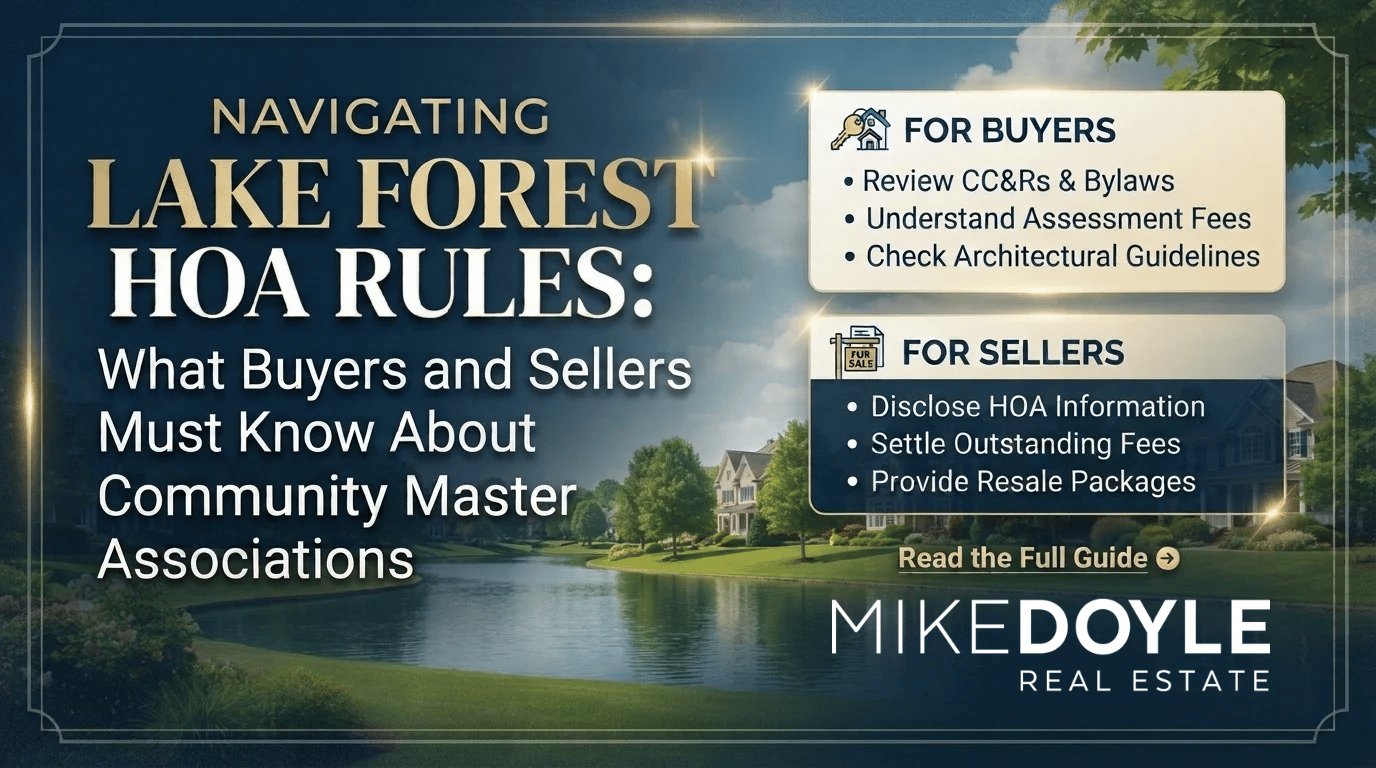
Navigating Lake Forest HOA Rules: What Buyers and Sellers Must Know About Community Master Associations
Mike Doyle November 25, 2026
If you're buying or selling a home in Lake Forest, California, there's something I always recommend paying close attention to: the HOA.
Lake Forest has several planned communities with homeowners associations (HOAs), and some properties are subject to more than one layer of association rules. You may have a neighborhood HOA, a master association, or both. And while these associations help maintain the appearance, amenities, and overall standards of a community, they can also have a significant impact on your ownership experience.
I've worked with buyers and sellers throughout Lake Forest and South Orange County for years, and one thing I've learned is that understanding the HOA rules before closing can save you from some expensive surprises later.
Whether you're buying your first home in Lake Forest, selling a property in an HOA community, or moving from one neighborhood to another, here's what I think you should know about Lake Forest HOA rules and community master associations.
One of the first things I explain to buyers is that not all HOAs operate the same way.
In some Lake Forest neighborhoods, homeowners belong to a single homeowners association. In others, there may be a neighborhood association and a larger master association overseeing the overall community.
A master association generally handles broader community responsibilities, such as shared amenities, landscaping, common areas, recreational facilities, and community-wide standards.
A neighborhood HOA may have additional responsibilities specific to a particular development, including architectural guidelines, exterior maintenance requirements, landscaping restrictions, and neighborhood rules.
This means you could be paying more than one HOA assessment and be subject to more than one set of governing documents.
When I'm helping someone purchase a home in Lake Forest, I don't want them looking at just the monthly HOA dues. I want them to understand exactly which associations govern the property and what those associations are responsible for.
Let's talk about HOA fees because they can make a difference in your monthly housing budget.
When buyers compare homes in Lake Forest, they naturally look at the purchase price, mortgage payment, property taxes, and insurance. But HOA dues need to be included in that calculation.
Depending on the community, you could have a neighborhood HOA assessment, a master association assessment, or both.
And those fees aren't necessarily the same from one community to another.
Some associations provide access to amenities such as pools, parks, tennis courts, clubhouses, walking trails, and recreational facilities. Others focus primarily on maintaining common areas and enforcing community standards.
My advice is to look beyond the monthly payment.
Ask what the HOA fees actually cover, whether there are additional assessments, and whether the association has plans for major repairs or improvements.
I also recommend reviewing the association's financial statements and reserve study. A community with healthy reserves is generally in a better position to handle future maintenance expenses without relying heavily on special assessments.
For buyers in the Lake Forest real estate market, this is an important part of evaluating the true cost of homeownership.
This is where things can get interesting.
When you purchase a home in a Lake Forest HOA community, you aren't necessarily free to make every change you want to your property.
Most homeowners associations have Covenants, Conditions, and Restrictions (CC&Rs), along with architectural guidelines and community rules.
These documents may regulate things such as:
For example, let's say you purchase a home in Lake Forest and want to replace the front landscaping, install a new patio cover, or change the exterior appearance of the property.
You may need written HOA approval before starting the project.
I've seen buyers get excited about the possibility of making improvements, only to discover later that the association has restrictions they weren't expecting.
That's why I always encourage buyers to review the architectural guidelines before closing, especially if they have plans to remodel or personalize the property.
When purchasing a home in a Lake Forest HOA community, the HOA document package is one of the most important parts of the due diligence process.
I don't consider it something buyers should simply skim through or sign without understanding.
Here are some of the documents I recommend reviewing carefully:
1. CC&Rs (Covenants, Conditions, and Restrictions)
These outline the association's governing rules and restrictions. They explain what homeowners can and cannot do and establish the responsibilities of property owners and the association.
2. HOA Budget and Financial Statements
These provide insight into the association's financial health, operating expenses, income, and anticipated costs.
3. Reserve Study
A reserve study helps determine whether the association has sufficient funds set aside for major repairs and long-term maintenance.
4. Meeting Minutes
I like buyers to review recent HOA meeting minutes because they can reveal issues that may not be obvious from the property's appearance.
There could be discussions about upcoming repairs, insurance increases, disputes, special assessments, or changes to community rules.
5. Insurance Information
It's important to understand what the HOA's master insurance policy covers and what individual homeowners are responsible for insuring.
6. Pending Special Assessments
A community may have an upcoming expense that isn't reflected in the current monthly HOA dues. Buyers should understand whether special assessments have been approved, proposed, or discussed.
The goal is to understand the financial and operational condition of the association before committing to the purchase.
One of the things I pay particular attention to when reviewing Lake Forest HOA documents is the possibility of special assessments.
A special assessment is an additional charge imposed on homeowners to cover expenses that aren't adequately funded through regular HOA dues or existing reserves.
For example, an association may need to repair common-area structures, replace aging equipment, improve drainage, address unexpected maintenance problems, or cover a major insurance-related expense.
If the association doesn't have enough money in reserves, homeowners may be required to contribute additional funds.
Depending on the community and the project, these assessments can be substantial.
This is why I don't just look at whether the HOA is currently charging $100, $200, or $400 per month. I want to understand whether those dues are sufficient to support the community's long-term financial needs.
For buyers considering a home in Lake Forest, reviewing the reserve study, financial statements, and meeting minutes can provide valuable information.
HOA requirements aren't just important for buyers. Sellers need to pay attention, too.
If you're selling a home in a Lake Forest HOA community, there are several things that can affect your transaction.
First, make sure you understand whether there are outstanding HOA balances, unpaid assessments, or unresolved violations associated with your property.
For example, if you've made exterior improvements without receiving the required HOA approval, that could become an issue during the transaction.
Perhaps you installed a patio cover, changed the landscaping, or modified an exterior feature several years ago. Even if everything looks great, the association may have records showing that approval was never obtained.
I recommend addressing these issues as early as possible rather than waiting until we're already in escrow.
Another important consideration is the HOA document package.
During a typical California resale transaction involving an HOA, the seller generally needs to provide applicable governing documents and required association disclosures under California law. Buyers should receive an opportunity to review those documents within the applicable transaction timelines.
There may also be HOA transfer fees, document preparation fees, and other charges associated with the sale.
I like to identify these costs upfront so sellers have a more accurate picture of their expected closing expenses.
One of the advantages of living in certain Lake Forest communities is access to shared amenities.
Depending on the neighborhood and association, homeowners may enjoy:
For example, some homes in the Hidden Lakes community have access to the Lake Forest Beach and Tennis Club.
For buyers, these amenities can be an important part of the lifestyle and overall value of a property.
However, I always recommend confirming exactly which amenities come with the property, whether access is included in the regular HOA assessment, and whether there are additional fees or restrictions.
Don't assume that every homeowner in Lake Forest has access to the same facilities simply because they live in the same general area.
The specific association and governing documents matter.
When I'm helping someone buy a home in Lake Forest, I want them to evaluate more than the kitchen, bedrooms, backyard, and floor plan.
I want them to understand the entire ownership experience.
That includes the neighborhood, HOA structure, monthly assessments, community amenities, architectural restrictions, financial reserves, and any potential issues that could affect future ownership.
The same applies to sellers.
If you're preparing to sell a home in a Lake Forest HOA community, having your HOA information organized and addressing any outstanding issues can help make the transaction smoother.
The South Orange County real estate market has plenty of different community types, and HOA rules can vary significantly even between neighborhoods that are only a few miles apart.
That's why I never recommend assuming that the rules in one Lake Forest community automatically apply to another.
Buying a home in Lake Forest is a major investment, and understanding the homeowners association should be part of the decision-making process.
HOA fees, master association requirements, community rules, reserve funding, and potential special assessments can all affect the long-term cost and experience of owning a home.
My approach is simple: I want my clients to understand what they're buying before they close escrow.
If you're considering purchasing or selling a home in Lake Forest, I'd be happy to help you understand the local market, identify the HOA-related questions worth asking, and navigate the transaction from beginning to end.
Thinking about buying or selling a home in Lake Forest or elsewhere in South Orange County?
Let's talk before you make your next move.
Mike Doyle | Coldwell Banker
Your South Orange County Real Estate Resource
Stay up to date on the latest real estate trends.
If you're buying or selling a home in Lake Forest, California, there's something I always recommend paying close attention to: the HOA.

Real Estate
Today's buyers have more homes to choose from and they’re feeling pinched by today’s mortgage rates. That makes them more selective. And that means having the right pr… Read more


Buying and selling a home at the same time can be complicated, especially in a competitive South Orange County market. Here's how the right strategy, timing, and prepa… Read more
Selling your house is a big step, and you want it to go smoothly. And with houses taking a little longer to sell these days, renting it out might start to sound like a… Read more
For expert real estate services, reach out to Mike Doyle. Whether you're buying, selling, or renting, navigate the process with confidence. Contact him today to ensure a smooth and informed real estate journey.